August.2014
3 Mins
Implant-Associated Soft Tissue Defects in the Anterior Maxilla: A Randomized Control Trial Comparing Subepithelial Connective Tissue Graft and Acellular Dermal Matrix Allograft
Implant-Associated Soft Tissue Defects in the Anterior Maxilla: A Randomized Control Trial Comparing Subepithelial Connective Tissue Graft and Acellular Dermal Matrix Allograft
Implant-Associated Soft Tissue Defects in the Anterior Maxilla: A Randomized Control Trial Comparing Subepithelial Connective Tissue Graft and Acellular Dermal Matrix Allograft

Anderson LE, Inglehart MR, El Kholy K, Eber R, Wang HL
Implant Dent.
Abstract
Purpose
This randomized controlled clinical pilot trial compared the efficacy of 2 soft tissue grafting methods for correcting esthetic discrepancies associated with definitively restored implant crowns.
Materials and methods
Thirteen patients presenting with implants displaying recession, thin biotype, concavity defects, or a combination thereof associated with single crowned dental implants randomly received subepithelial connective tissue grafts (SCTG) in the control group (N = 7) or acellular dermal matrix (ADM) allografts in the test group (N = 6), both under coronally positioned flaps. Data regarding soft tissue, hard tissue, esthetics, and quality of life (QoL) parameters were collected over 6 months.
Results
Both groups gained tissue thickness (SCTG: 63% and ADM: 105%), reduced concavity measures (SCTG: 82% and ADM: 96%), and improved recessions (SCTG: 40% and ADM: 28%) from baseline to 6 months. Clinicians determined improvement in esthetics for both groups (P = 0.001), unlike patients who did not change their esthetic ratings. No statistical differences were noted for QoL assessment; however, ADM subjects had more eventful wound healing (P = 0.021).
Conclusion
Within the limitations of this study, both SCTG and ADM result in increased mucosal thickness, reduction in concavity dimensions, and have a potential for recession reduction on definitively restored dental implants.
Keywords
soft tissue grafting, connective tissue graft, acellular dermal matrix, implant esthetics, anterior maxilla, mucosal thickness, recession reduction, randomized controlled trial
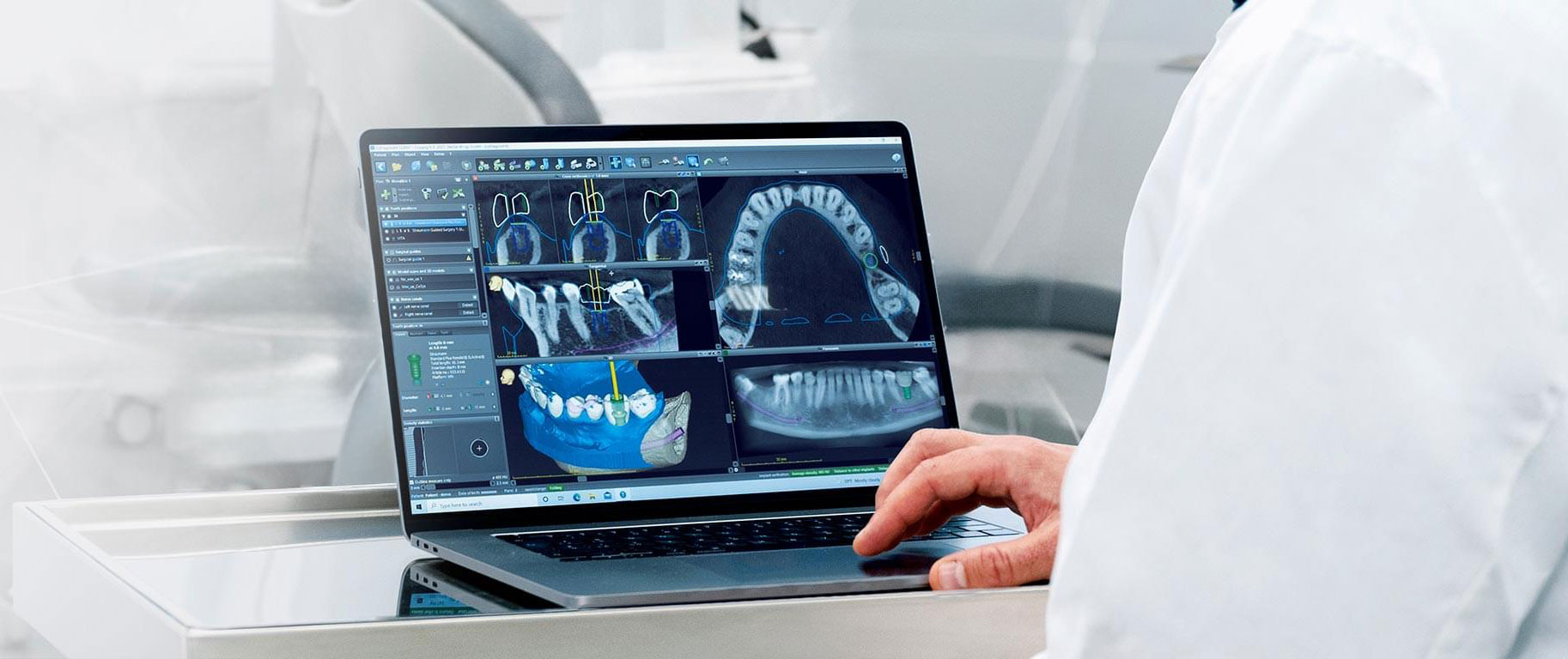
No technician, no engineer.
Just surgical planning by one dentist for another.
No technician, no engineer.
Just surgical planning by one dentist for another.
No technician, no engineer.
Just surgical planning by one dentist for another.
August.2014
3 Mins
Implant-Associated Soft Tissue Defects in the Anterior Maxilla: A Randomized Control Trial Comparing Subepithelial Connective Tissue Graft and Acellular Dermal Matrix Allograft
Implant-Associated Soft Tissue Defects in the Anterior Maxilla: A Randomized Control Trial Comparing Subepithelial Connective Tissue Graft and Acellular Dermal Matrix Allograft
Implant-Associated Soft Tissue Defects in the Anterior Maxilla: A Randomized Control Trial Comparing Subepithelial Connective Tissue Graft and Acellular Dermal Matrix Allograft
Anderson LE, Inglehart MR, El Kholy K, Eber R, Wang HL
Implant Dent.
Abstract
Purpose
This randomized controlled clinical pilot trial compared the efficacy of 2 soft tissue grafting methods for correcting esthetic discrepancies associated with definitively restored implant crowns.
Materials and methods
Thirteen patients presenting with implants displaying recession, thin biotype, concavity defects, or a combination thereof associated with single crowned dental implants randomly received subepithelial connective tissue grafts (SCTG) in the control group (N = 7) or acellular dermal matrix (ADM) allografts in the test group (N = 6), both under coronally positioned flaps. Data regarding soft tissue, hard tissue, esthetics, and quality of life (QoL) parameters were collected over 6 months.
Results
Both groups gained tissue thickness (SCTG: 63% and ADM: 105%), reduced concavity measures (SCTG: 82% and ADM: 96%), and improved recessions (SCTG: 40% and ADM: 28%) from baseline to 6 months. Clinicians determined improvement in esthetics for both groups (P = 0.001), unlike patients who did not change their esthetic ratings. No statistical differences were noted for QoL assessment; however, ADM subjects had more eventful wound healing (P = 0.021).
Conclusion
Within the limitations of this study, both SCTG and ADM result in increased mucosal thickness, reduction in concavity dimensions, and have a potential for recession reduction on definitively restored dental implants.
Keywords
soft tissue grafting, connective tissue graft, acellular dermal matrix, implant esthetics, anterior maxilla, mucosal thickness, recession reduction, randomized controlled trial
No technician, no engineer.
Just surgical planning by one dentist for another.
No technician, no engineer.
Just surgical planning by one dentist for another.
No technician, no engineer.
Just surgical planning by one dentist for another.