February.2019
3 Mins
The Influence of Guided Sleeve Height, Drilling Distance, and Drilling Key Length on the Accuracy of Static Computer-Assisted Implant Surgery
The Influence of Guided Sleeve Height, Drilling Distance, and Drilling Key Length on the Accuracy of Static Computer-Assisted Implant Surgery
The Influence of Guided Sleeve Height, Drilling Distance, and Drilling Key Length on the Accuracy of Static Computer-Assisted Implant Surgery

El Kholy K, Janner SFM, Schimmel M, Buser D
Clin Implant Dent Relat Res.
Summary
Purpose
To measure how guide sleeve height, drilling distance and drill key height affect the accuracy of static computer-assisted implant surgery (sCAIS).
Materials and methods
In this in vitro study, implants were placed in duplicate dental models following one standardized planning and guided surgery protocol, and their final positions were compared with the planned positions. Sleeve heights of 2, 4 and 6 mm and key heights of 1 and 3 mm were randomly distributed across six test groups, with implant lengths from 10 to 16 mm. Three-dimensional deviation at the implant shoulder and apex, and angular deviation, were measured for each group.
Results
Sleeve height alone and implant length alone did not significantly change accuracy. Deviation increased as the drilling distance below the sleeve increased: an 18 mm drilling distance was significantly less accurate than 14 or 16 mm, whatever the sleeve height or implant length. A 3 mm key gave significantly less deviation than a 1 mm key.
Conclusion
Keeping the drilling distance below the sleeve short, with shorter sleeve heights or shorter implants, and using a longer drill key, significantly improves the accuracy of guided implant surgery.
What this means for your practice
Guide accuracy depends on design choices made at the planning stage, such as sleeve position, drilling distance and key length, not only on the guide itself.
Keywords
accuracy, guided surgery, surgical guide, sleeve height, drilling distance, static computer-assisted implant surgery, sCAIS
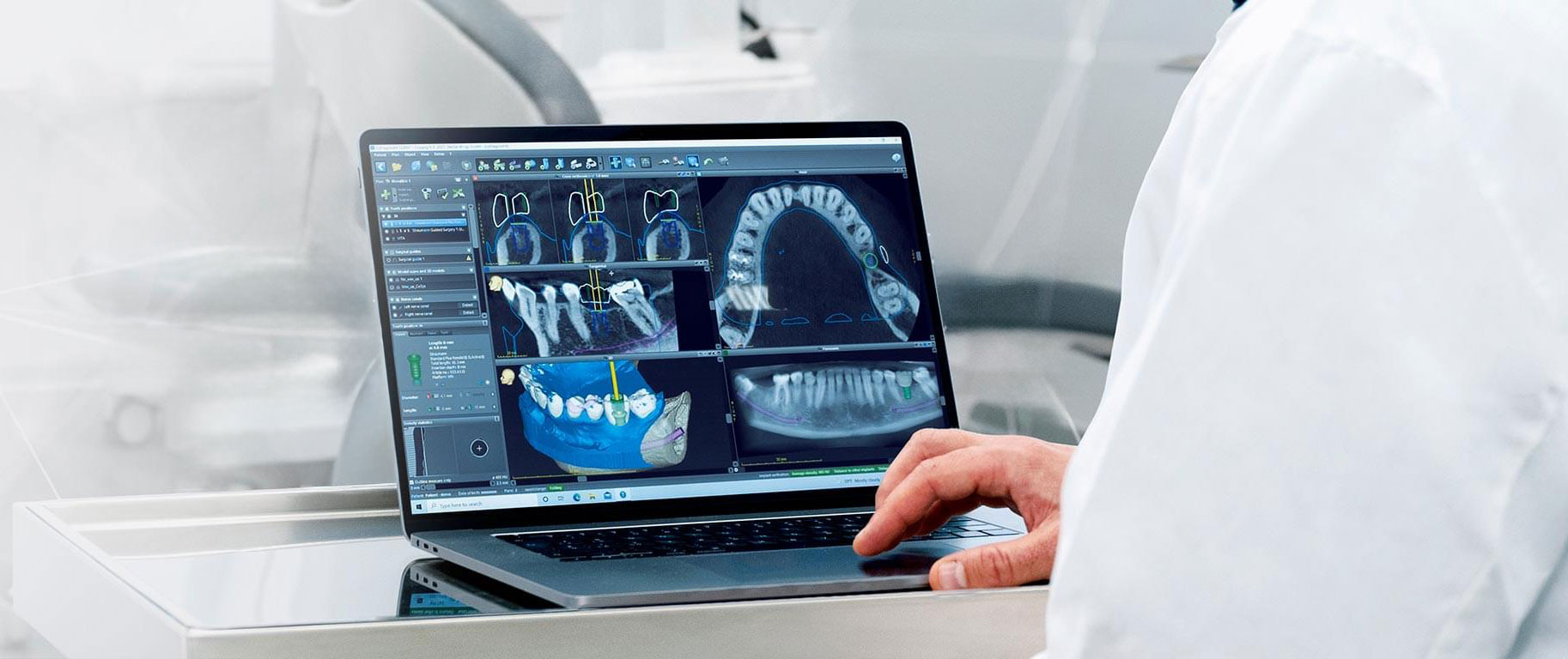
No technician, no engineer.
Just surgical planning by one dentist for another.
No technician, no engineer.
Just surgical planning by one dentist for another.
No technician, no engineer.
Just surgical planning by one dentist for another.
February.2019
3 Mins
The Influence of Guided Sleeve Height, Drilling Distance, and Drilling Key Length on the Accuracy of Static Computer-Assisted Implant Surgery
The Influence of Guided Sleeve Height, Drilling Distance, and Drilling Key Length on the Accuracy of Static Computer-Assisted Implant Surgery
The Influence of Guided Sleeve Height, Drilling Distance, and Drilling Key Length on the Accuracy of Static Computer-Assisted Implant Surgery
El Kholy K, Janner SFM, Schimmel M, Buser D
Clin Implant Dent Relat Res.
Summary
Purpose
To measure how guide sleeve height, drilling distance and drill key height affect the accuracy of static computer-assisted implant surgery (sCAIS).
Materials and methods
In this in vitro study, implants were placed in duplicate dental models following one standardized planning and guided surgery protocol, and their final positions were compared with the planned positions. Sleeve heights of 2, 4 and 6 mm and key heights of 1 and 3 mm were randomly distributed across six test groups, with implant lengths from 10 to 16 mm. Three-dimensional deviation at the implant shoulder and apex, and angular deviation, were measured for each group.
Results
Sleeve height alone and implant length alone did not significantly change accuracy. Deviation increased as the drilling distance below the sleeve increased: an 18 mm drilling distance was significantly less accurate than 14 or 16 mm, whatever the sleeve height or implant length. A 3 mm key gave significantly less deviation than a 1 mm key.
Conclusion
Keeping the drilling distance below the sleeve short, with shorter sleeve heights or shorter implants, and using a longer drill key, significantly improves the accuracy of guided implant surgery.
What this means for your practice
Guide accuracy depends on design choices made at the planning stage, such as sleeve position, drilling distance and key length, not only on the guide itself.
Keywords
accuracy, guided surgery, surgical guide, sleeve height, drilling distance, static computer-assisted implant surgery, sCAIS
No technician, no engineer.
Just surgical planning by one dentist for another.
No technician, no engineer.
Just surgical planning by one dentist for another.
No technician, no engineer.
Just surgical planning by one dentist for another.